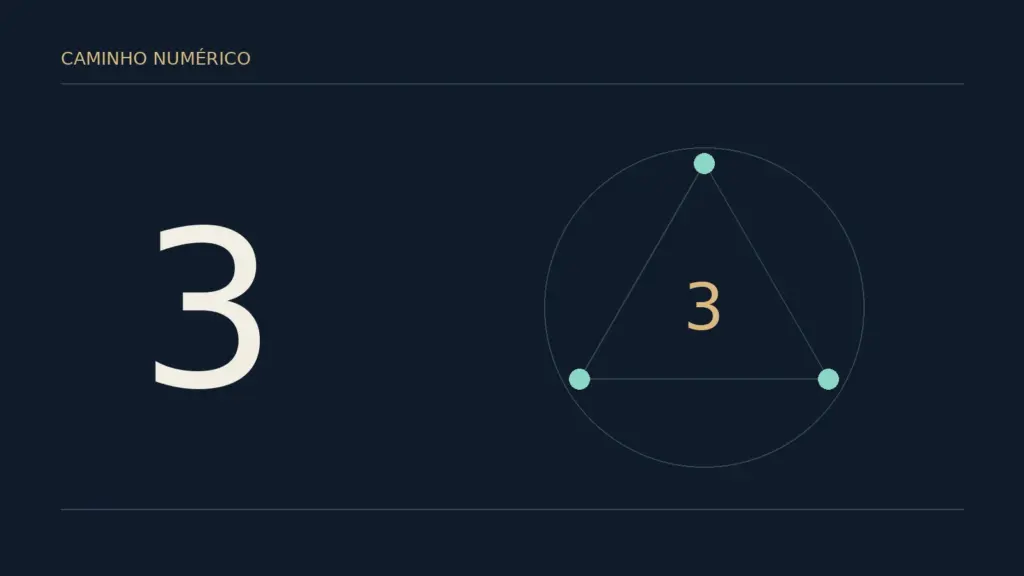
Number 3 in numerology is associated with expression and creativity. This is an interpretation of a symbolic tradition, not a scientific assessment of personality nor a prediction. You can use the theme to formulate questions about your experience, without assuming that a result defines who you are.
What 3 means, as a theme for reflection
A frequent association of 3 is giving form to an idea so that another person can understand it. This can happen in a conversation, in a drawing, in a recipe explained to someone or in a text. Creativity, in this sense, does not require an artistic profession nor an audience. The useful question is: what do I want to say and what is the clearest way to say it?
The less comfortable side of this image is starting many things and leaving them all halfway. It can also serve to think about the difference between wanting to share and needing approval. If an idea does not receive an enthusiastic response, that does not prove it has no value. And if you receive praise, it does not replace reviewing the work.
How to calculate: examples that arrive at 3
Before interpreting, identify the field you are calculating. The full date, the letters of the name, the day of the month and the calendar year are not interchangeable data. The same digit can appear in several calculations without turning those fields into a single reading.
Reduction of a total
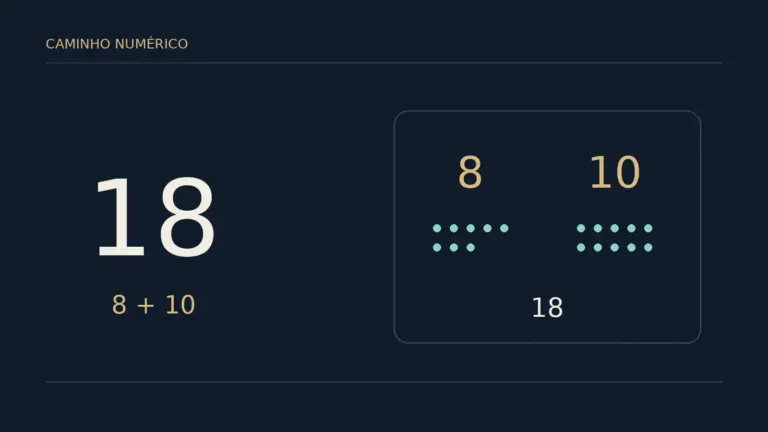
Simple reduction sums the digits. These two examples show only the operation, without attributing a date or a person to them:
- 12/3: 1 + 2 = 3
- 21/3: 2 + 1 = 3
Life path
In this site’s method, you reduce day, month and year separately, preserving 11, 22 and 33 at each stage; then you sum and reduce again, with the same rule. For the fictitious date 9 January 2000, the day becomes 9, the month becomes 1 and the year reduces to 2. The sum is 9 + 1 + 2 = 12 → 1 + 2 = 3. Here, the life path is 3. Check the sequence in the life path calculator.
Expression number
The name uses the A to Z table in cycles of 1 to 9: A is worth 1, I is worth 9, J returns to 1 and Z is worth 8. In the didactic example RITA, the calculation is R(9) + I(9) + T(2) + A(1) = 21; the sum of the digits gives 3. This is only a fictitious first name. To calculate the expression number for the chart, follow the full name convention indicated in the expression number guide.
Personal year
The calculator uses January to December. Reduce the day, the month and the chosen year to a single digit each; sum the three and keep 11 only if that sum is exactly 11. In the remaining cases, reduce to a single digit. For someone born on 1 January, in 2026: 1 + 1 + 1 = 3. The last 1 comes from 2 + 0 + 2 + 6 = 10, then 1 + 0 = 1. Consult the personal year to compare other examples.
How to distinguish the fields in your chart
| Field | Data | What to record |
|---|---|---|
| Life path | Full date | Steps and result |
| Expression | All letters of the name | Table and total before reducing |
| Day of birth | Day of the month | Original day and chosen reduction |
| Personal year | Day, month and chosen calendar year | Year to which the calculation refers |
Keep the fields separate. The day number can be presented as original value and simple reduction; identify that convention. In the name, 11, 22 and 33 interrupt the reduction when they appear. Therefore, a result 22 is not presented as a simple 4, nor 33 as a simple 6. If you compare calculators, check first the order of operations and the master rule.
3 and the other numbers
3 and 5 often appear associated with variety. To distinguish them as study themes, 3 places the focus on expression: transforming an idea into words, images or sounds. 5 highlights the experience of change. 4, in turn, serves as a counterpoint to improvisation, bringing the question of organisation and continuity. These are choices of symbolic language, not incompatible types of people.
A situation to explore the theme
Imagine you want to explain an idea in a meeting. You open with four subjects, show several images and finish without formulating the request. The 3 theme can help you choose a main message and a closing sentence. You do not need to have 3 in your chart to do this work. The concrete criterion is whether the listener can say, in their own words, what you proposed.
An optional and concrete exercise
Choose a small idea and write a text that finishes it, instead of opening more subjects. At the beginning, say what you are trying to explain. In the middle, use an example. At the end, formulate a question or a concrete proposal. Read aloud and cut a sentence that repeats another. If you wish, show the text to someone and ask only: “What did you understand?” The answer helps to revise the communication; it does not measure your worth nor confirm the symbolism of the number.
Record what you observed and a situation where the interpretation did not fit. An example that seems to confirm the theme does not prove that the number caused it. You can also repeat the exercise without calculating anything: the utility lies in the question and what you do with it, not in a demonstrated property of the digit.
Frequently asked questions
Does number 3 mean artistic talent?
No. It is a traditional association with expression and creativity. A talent develops with practice, opportunities and learning; it is not verified by summing a date or a name.
Does the same number in the name and in the date mean the same thing?
No. The data and the field of interpretation are different. name numerology uses letters; the life path uses the full date. Do not sum the results to create a new field without an explicit rule.
Does seeing the repeated number confirm this interpretation?
No. Finding a digit in times, prices or number plates does not demonstrate an external message. If you want to study the symbolism, distinguish the pattern you observed from the explanation you are attributing to it.
Caminho Numérico
Keep exploring numerology
Get new articles on numerology, tarot and astrology to explore the ideas in this article further.