Lenormand is a 36-card system that combines familiar images such as the House, Letter and Key. The standard Petit Lenormand deck is different from a 78-card tarot deck. Beginners can start with a few symbols and practise connecting two or three cards in a short sentence.
In Portuguese, this deck is often called baralho cigano or tarot cigano. This guide covers the traditional set, a reference table and a worked exercise. Interpretations are symbolic prompts for reflection. A card cannot establish future events, another person’s feelings or a medical condition.
Study materials on Amazon Spain
As an Amazon Associate I earn from qualifying purchases.
You can start with materials you already own. These links open searches on Amazon Spain. Before buying, check the edition, guidebook language, seller and delivery to your country.
Lenormand and tarot: what is the difference?
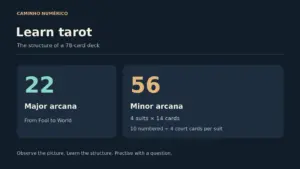
Petit Lenormand has 36 numbered cards with no division into major and minor arcana. A standard tarot deck has 78 cards: 22 major arcana and 56 minor arcana. This matters when learning because a shared card name does not mean the two systems share its interpretation.
| Feature | Petit Lenormand | Tarot |
|---|---|---|
| Standard set | 36 cards | 78 cards |
| Structure | Numbered sequence of symbols | 22 major arcana and four suits |
| Starting exercise here | Join images into a sentence | Observe the scene and the card’s position |
| The Tower, for example | May suggest distance, institutions or boundaries | Often associated with disruption and change |
These approaches are not universal rules. A particular deck’s guidebook may use different conventions. If your cards include Cups, Wands, Swords and Pentacles, start with our guide to learning tarot and the four minor arcana suits.
The 36 Lenormand cards
Use this table as a starting point. The final column offers study prompts rather than fixed answers. Some editions use Flowers instead of Bouquet, Paths instead of Crossroads, or the singular Lily. Check the number when a label differs.
| No. | Card | Study prompt |
|---|---|---|
| 1 | Rider | Arrival, movement |
| 2 | Clover | Brief opportunity |
| 3 | Ship | Distance, exploration |
| 4 | House | Familiar surroundings |
| 5 | Tree | Roots, growth |
| 6 | Clouds | Unclear information |
| 7 | Snake | An indirect route |
| 8 | Coffin | Closure |
| 9 | Bouquet | A gesture of appreciation |
| 10 | Scythe | Cutting, separation |
| 11 | Whip | Repetition, tension |
| 12 | Birds | Conversation, restlessness |
| 13 | Child | Beginnings, small scale |
| 14 | Fox | Caution, strategy |
| 15 | Bear | Protection, strength |
| 16 | Stars | Direction, aspiration |
| 17 | Stork | Transition |
| 18 | Dog | Companionship, loyalty |
| 19 | Tower | Boundaries, institution |
| 20 | Garden | Gathering, public space |
| 21 | Mountain | Obstacle |
| 22 | Crossroads | Alternatives |
| 23 | Mice | Gradual depletion |
| 24 | Heart | Affection |
| 25 | Ring | Agreement, commitment |
| 26 | Book | Knowledge to explore |
| 27 | Letter | Message, document |
| 28 | Man | A chosen person or role |
| 29 | Woman | A chosen person or role |
| 30 | Lilies | Calm, maturity |
| 31 | Sun | Clarity, vitality |
| 32 | Moon | Imagination, recognition |
| 33 | Key | Access, solution |
| 34 | Fish | Flow, resources |
| 35 | Anchor | Stability |
| 36 | Cross | Responsibility, burden |
Man and Woman retain the traditional names in the set. For an exercise, you can assign a person or role before drawing, while respecting the participants’ identities. These cards do not determine a stranger’s gender, someone’s sexual orientation or whether a relationship exists.
Choosing a beginner deck
Look for clearly printed numbers and recognisable symbols. A guidebook in a language you understand makes it easier to keep the same conventions throughout your first exercises. Detailed artwork can be attractive, but being able to distinguish the Book from the Letter or the Tower from the House matters more for this practice.
Some editions include alternative people cards or extra symbols. To follow this guide, separate the cards numbered 1 to 36 and put the additions aside. You do not need accessories, crystals or a ritual to observe the images and learn how combinations work.
Your first three-card Lenormand spread
- Write an open question. For example: “What could I organise before presenting this project?” Choose something that leaves room for reflection and a practical action.
- Set the reading convention first. In this exercise, read the cards as a sentence from left to right. Do not assign past, present and future positions.
- Shuffle and draw three cards. Place them upright. Leave reversals out of this exercise to keep the number of variables manageable.
- Describe each image. Write one word per card before checking the book. Separate what you can see from what you imagine.
- Try two interpretations. Connect the first card to the second and the second to the third. Then write a sentence that relates to your question.
- Record a checkable action. You might review a document or ask for clarification. An interpretation does not turn a possibility into a fact.
One card is enough to study an image. Three let you practise context without managing a full 36-card layout. Keep the same method for several exercises so you can identify what is changing between readings.
Worked example: Rider, Letter and Key
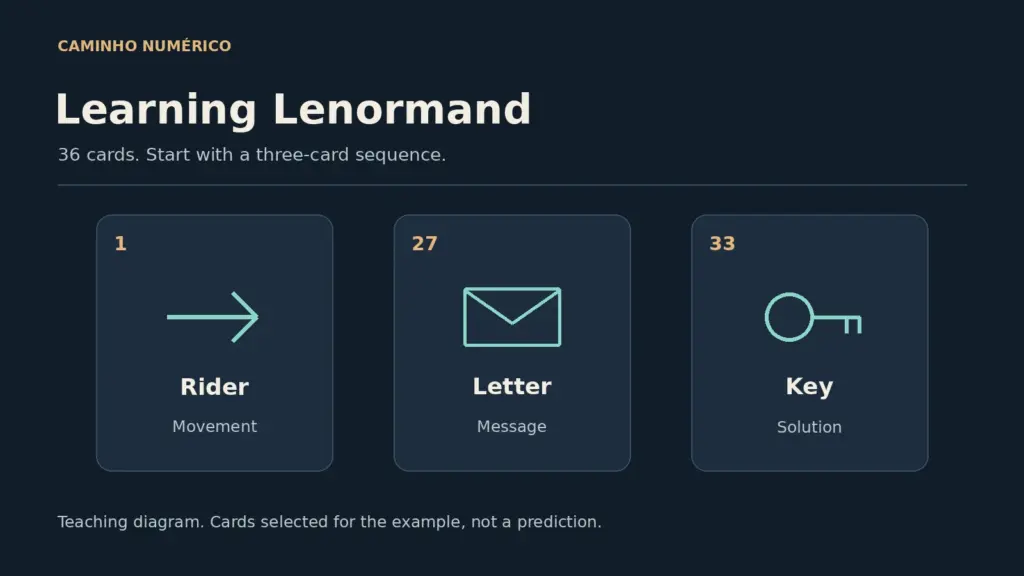
This is a fictional teaching example with deliberately selected cards. Imagine the question: “How can I prepare the communication for a project?” The sequence is Rider (1), Letter (27) and Key (33).
- Rider: we explore arrival or movement.
- Letter: we focus on a message or document.
- Key: we consider a solution or point of access.
One possible interpretation is: “Deliver a written message that makes the required next step clear.” A practical response would be to draft an email stating the goal, the unresolved question and the reply you need. Another interpretation could focus on receiving information: check that you have the necessary document before proceeding.
The limit matters. These cards do not prove that an offer is coming or guarantee that anyone will reply. The exercise helps you form possibilities and improve the question. If a second interpretation fits equally well, record it too.
Learning combinations without memorising hundreds of answers
Start with pairs and explain the connection in your own words. House and Book might prompt you to think about a study space at home. Book and House might put the focus on information about a place. These are language exercises: changing the order affects the reading only if your chosen convention gives order that function.
Avoid treating every pair as a compulsory event. A symbol can suggest several ideas, while the question narrows the context. With the Anchor, compare “What gives me stability?” and “What is holding me back?” The same image can generate different useful questions.
Make four columns in your notebook: question, cards, interpretation and action. Later, add what actually happened, including anything that did not match your reading. This record can help you spot vague statements and the habit of noticing matches while forgetting mismatches.
A seven-day study plan
- Check the numbers from 1 to 36 and name the images without consulting meanings.
- Choose House, Tree and Garden, then describe the visual differences.
- Study Book and Letter: stored knowledge and written communication can suggest different questions.
- Select two cards and write two possible connecting sentences.
- Repeat this guide’s three-card exercise with your own question.
- Check the guidebook and note where your interpretation differs from the deck’s convention.
- Review the notebook, keep one useful observation and choose the next small exercise.
The aim is to learn a process during the week, rather than master the whole deck. Once you can explain your choices, you can try five cards. A full tableau involves many relationships and can wait.
Frequently asked questions
Does Lenormand have 36 or 78 cards?
Traditional Petit Lenormand has 36 cards. Standard tarot has 78. Some editions include extras, so check the description and numbering of your set.
Do I need a special gift to learn?
Studying images, comparing interpretations and keeping a journal require practice and attention. You do not need to assume supernatural abilities.
Can I use reversed cards?
You can follow a method that uses them, but this guide uses upright cards only. Decide on the convention before drawing so that you do not change the rules to fit a result.
Does the Coffin predict a death?
It does not establish that anyone will die. Here it is a study prompt about endings and closure. No card replaces medical information or justifies alarming someone.
Can I mix tarot and Lenormand?
You can design a combined exercise, but learn the separate structures first. Label the methods in your notes and avoid automatically assigning major arcana meanings to cards with similar names.
Sources and editorial method
The publisher’s listing for Lo Scarabeo’s Oracolo Lenormand confirms a 36-card set. The Metropolitan Museum’s explanation of tarot structure supports the comparison with 78 cards. The Lenormand card library provides a reference for English card names.
Caminho Numérico wrote the prompts, questions and worked exercise for this guide. They describe a symbolic practice; deck references do not demonstrate predictive ability. For further study of imagery, explore our visual guide to tarot card meanings.
Caminho Numérico
Keep exploring numerology
Get new articles on numerology, tarot and astrology to explore the ideas in this article further.