To learn tarot, start with the structure of the 78 cards, study one image at a time and practise short spreads with a defined question. You do not need to memorise every meaning before beginning. Learn to separate what the picture shows, the interpretation you give it and the facts you know about the situation.
This beginner’s guide offers a study method, a seven-day plan and a worked spread. It approaches tarot as a symbolic language for reflection, without promising to predict events or reveal another person’s thoughts.
Study materials on Amazon Spain
As an Amazon Associate I earn from qualifying purchases.
You can start with materials you already own. These links open searches on Amazon Spain. Before buying, check the edition, guidebook language, seller and delivery to your country.
Choosing your first tarot deck
Choose images you can examine comfortably and a guidebook in a language you understand. In a Rider-Waite-Smith-based deck, scenes on numbered cards help you describe actions, objects and relationships between figures. In Tarot de Marseille, many of those cards display arrangements of suit symbols, so the visual exercise differs.
Before buying, check the card count, language and whether the included guide explains that edition. You do not need several decks or accessories to learn. You can also begin with a deck you already own, keeping its conventions consistent through your first exercises.
Tarot structure: 22 major and 56 minor arcana
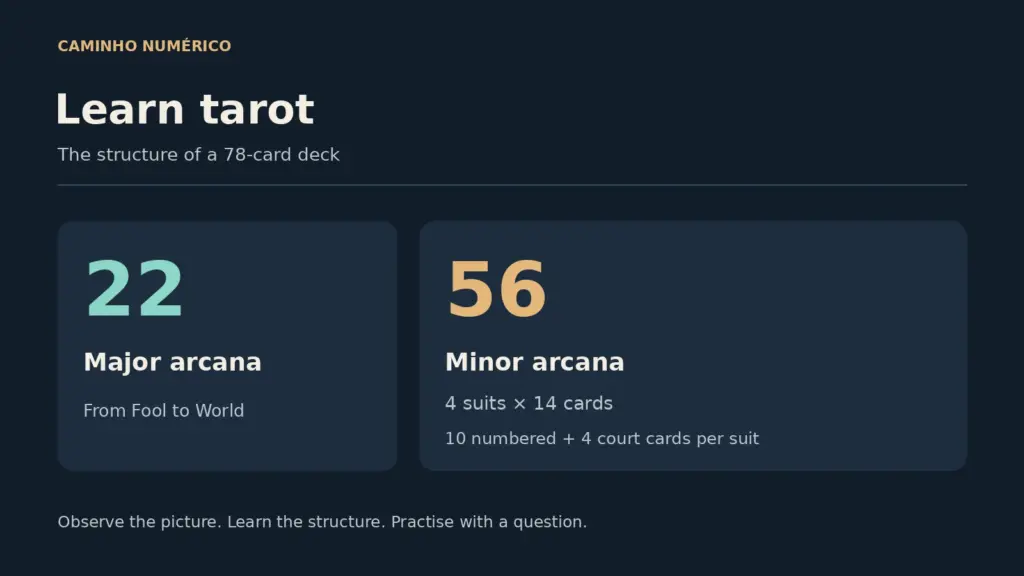
A standard tarot deck has 78 cards. The 22 major arcana include the Fool and the sequence through the World. The 56 minor arcana form four suits, each with ten numbered cards and four court cards. Names and the order of some cards vary between traditions.
| Suit | Common symbolic theme | Study question |
|---|---|---|
| Cups | Emotions and relationships | How do the figures relate to one another? |
| Wands | Action and creativity | What movement or initiative appears? |
| Swords | Thought and conflict | What tension or choice does the scene suggest? |
| Pentacles or Coins | Resources and practical life | What is being built or cared for? |
The associations in the table are reading conventions. See our minor arcana guide to study each group in more detail. A Pentacles card, for example, does not establish a fact about your finances.
Are tarot and Lenormand the same?
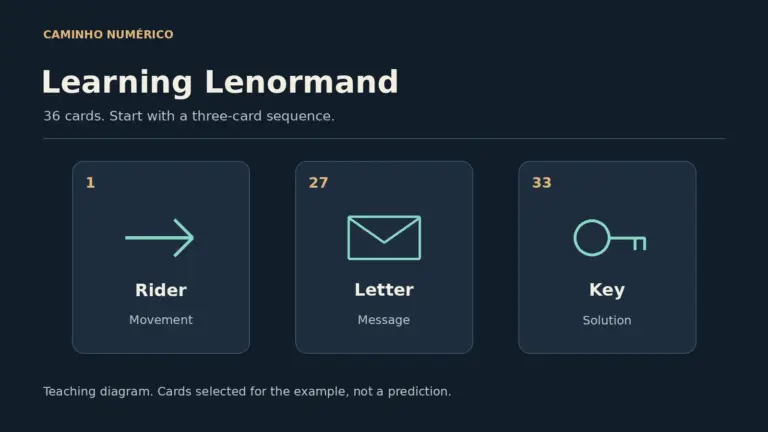
No. Petit Lenormand has a traditional set of 36 cards and a different approach to combining symbols. If your deck contains Rider, Letter and Key, follow our Lenormand beginner’s guide. Do not automatically transfer the Tower’s meaning from one system to the other.
Studying one card without memorising the book
- Describe what you see. Record three visible elements, such as a figure, an object and the direction of someone’s gaze.
- Suggest an interpretation. Write a sentence beginning “This picture makes me think of…”
- Check the guidebook. Compare your sentence with the edition’s convention and note a difference.
- Form a question. For example: “Which part of this situation have I not examined?”
- Record a limit. Write something the card does not allow you to conclude.
To study all 78 cards in 78 sessions, work through the deck in order or set studied cards aside. Drawing randomly and returning the card to the deck allows repeats and does not guarantee you will see every card in that period.
Your first three-card tarot spread
Set the positions before shuffling. A simple layout is situation, obstacle and possible action. Choose a question within your control, such as “What could I organise to finish this project?” Avoid asking for certainty about someone else’s wishes.
Place three cards from left to right. Describe each picture and relate it to the position you selected. Finish by writing an alternative interpretation. If your answer is vague enough to fit any situation, make the question more specific.
Example: Eight of Pentacles, Two of Swords and Temperance
These cards were selected for teaching; they are not the result of an actual draw. For the question about finishing a project, we could explore:
- Situation, Eight of Pentacles: repeated work and refinement. Which part of the task are you already practising?
- Obstacle, Two of Swords: an unresolved choice. What information is missing before you decide?
- Possible action, Temperance: adjusting pace and combining resources. How could you divide the work into manageable stages?
A concrete response would be to list the uncertainty blocking the task and set aside time to clarify it. The cards do not guarantee that the project will succeed. The exercise’s usefulness depends on the quality of your reflection and the actions you actually take.
Should beginners use reversed cards?
You can start with upright cards only. That reduces the conventions you need to manage while learning the structure. If you choose reversals, decide in advance what they mean in your method: contrast, difficulty expressing a theme or another rule explained by the guidebook.
An upside-down card does not automatically mean the opposite of its usual interpretation. Record the orientation and convention in your journal so you can explain the reading without changing the rules after seeing the result.
A study plan for your first week
- Separate major arcana, suits and court cards; check that you have 78 cards.
- Observe the Fool and Magician and describe differences between the images.
- Compare the four Aces to recognise each suit.
- Study a numbered card and a court card with the five-step method.
- Try a three-card spread using your own question.
- Review your journal and write a second interpretation for the same spread.
- Choose a theme to explore further and a question to clarify in the guidebook.
The purpose of the week is to learn a process. There is no universal deadline for becoming comfortable with the cards. Short, regular sessions make it easier to compare your notes than trying to absorb the whole deck at once.
Common beginner mistakes
Repeating a question until the answer feels right. Record the first reading and your reaction. Additional draws do not add factual information about the situation.
Confusing interpretation with evidence. Death does not establish a physical death, the Tower does not necessarily announce a disaster and a court card does not prove that someone is lying.
Ignoring what does not fit. Keep interpretations that did not make sense too. This helps you notice vague wording and the tendency to remember only coincidences.
Reading for someone without agreeing on limits. Explain that you are learning, ask for consent and respect a refusal. Do not use the cards for diagnoses or legal and financial decisions.
Frequently asked questions about learning tarot
Can I teach myself?
Yes. You can study images and practise with a guidebook and a journal. Comparing interpretations can help, provided you distinguish the conventions of different schools.
Do I need a special gift?
Observing images, learning symbols and forming questions are skills you can practise. This guide’s method does not assume supernatural abilities.
Do I need to cleanse the deck?
Rituals are personal choices rather than requirements for this exercise. Keep the cards dry, away from excessive heat and liquids, and follow the publisher’s care instructions.
Where can I look up meanings?
Our visual guide to tarot card meanings offers a reference for the symbolism. Use it alongside your deck’s manual to understand differences in names and pictures.
Source on deck structure and study method
The Metropolitan Museum explains tarot’s historical structure, including suit cards and trumps. Caminho Numérico wrote this page’s exercises, weekly plan and fictional spread to make the learning process observable and gradual.
Caminho Numérico
Keep exploring numerology
Get new articles on numerology, tarot and astrology to explore the ideas in this article further.