Tarot and matters of the heart
There are questions that keep you up at night. The ones you whisper into the dark when the house is quiet and your phone has stopped lighting up. “Does he still think about me?”, “Does this relationship have a future?”, “When will love finally find me?”
If you’ve ever asked yourself any of these — and let’s be honest, you have — then love tarot might be one of the most revealing tools you’ll ever encounter. Not because the cards are magical. But because they force you to look at what you already feel, the things you just haven’t had the courage to admit yet.
Tarot doesn’t tell you the future like reading a recipe. It shows you what’s happening right now — the underground currents, the hidden emotions, the patterns you keep repeating without realising. And when it comes to love, that kind of raw honesty is exactly what you need.
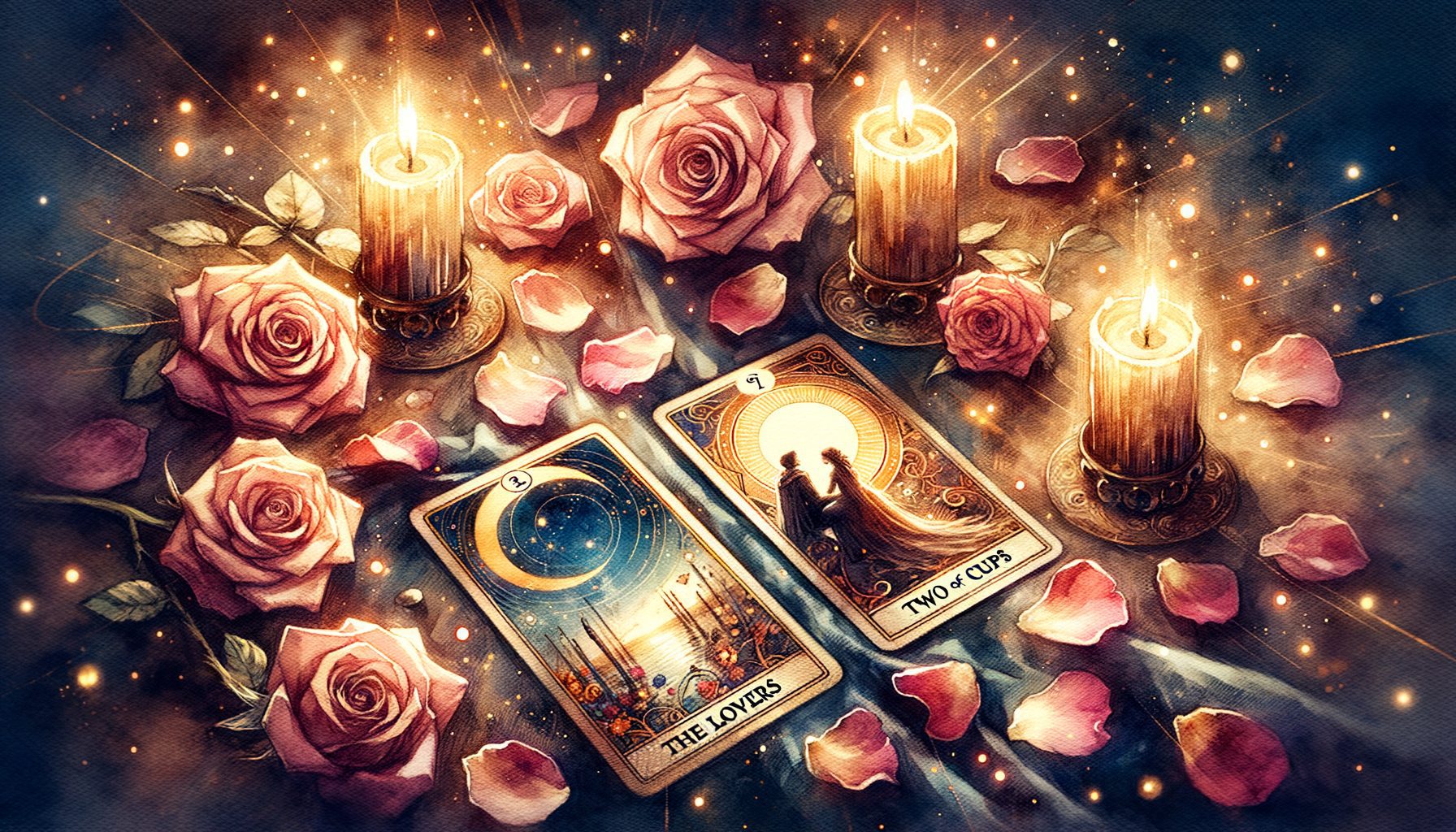
In this guide, I’ll teach you how to do a love tarot reading yourself, how to interpret the most important cards for romantic questions, and how to avoid the mistakes almost everyone makes in the beginning. Grab your deck, light a candle if you like, and let’s get into it.
Why tarot works so well for love
Love is, by nature, messy. Full of layers, of fears disguised as indifference, of desires dressed up as pride. And tarot is a language made of symbols — images that bypass the rational mind and speak directly to that part of you that knows, even when you pretend otherwise.
When you pull a card about a relationship, you’re not asking some mystical entity to reveal secrets. You’re creating a mirror. The cards reflect your emotions, your blocks, your hopes. And when you see them laid out on the table, what was once an emotional blur suddenly takes shape, takes form, takes a name.
Love tarot is especially powerful because romantic questions are the ones we resist analysing with clarity the most. We’re afraid of the answer. And the cards, by using symbolic language, allow us to approach the truth without the brutal impact of a direct statement.
The best cards for love
Not every card speaks of love — but there’s a group that, when they appear in a relationship reading, makes your heart skip. These are the ones you want to see:
The Lovers (VI)
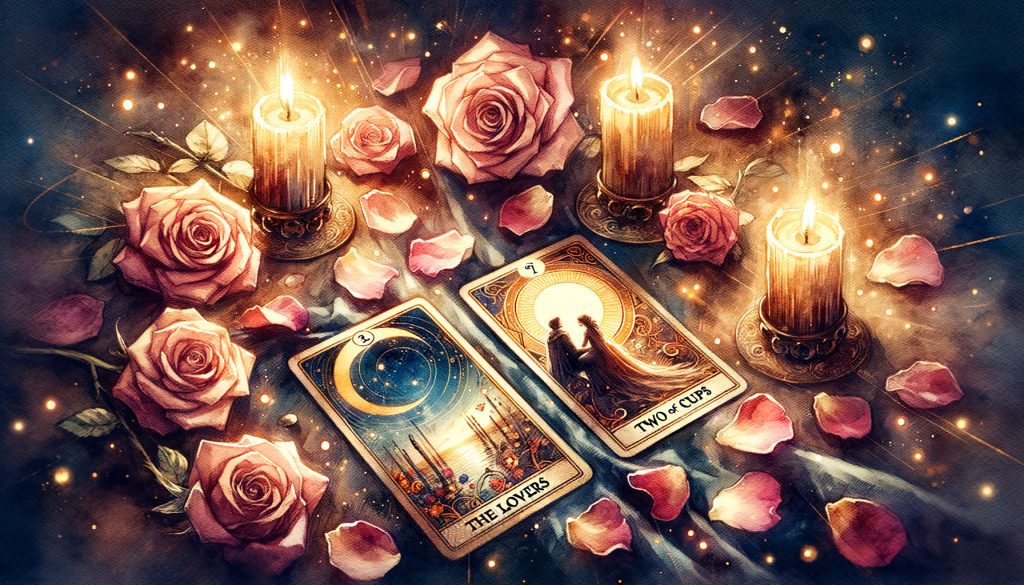
The most obvious card, yes, but not because it’s simple. The Lovers isn’t just about romance — it speaks of choice. Of looking at someone and consciously deciding that’s where you want to be. When this card appears, it’s a strong sign of genuine connection, of alignment between what you feel and what you’re living.
The Empress (III)
Sensuality, abundance, emotional fertility. The Empress is the love that nourishes, that cares, that blossoms. If you’re asking about a relationship, this card tells you there’s fertile ground — love can grow here, if you water it.
Two of Cups
If The Lovers is the grand decision, the Two of Cups is the moment. That instant when two gazes meet and both of you know. Partnership, reciprocity, mutual attraction. It’s the card of “I feel the same way.”
The Sun (XIX)
Pure joy, no shadows. When The Sun appears in a love tarot reading, it’s like throwing the windows wide open. The relationship breathes, there’s clarity, there’s uncomplicated happiness. It’s rare and beautiful — appreciate it when it shows up.
Ten of Cups
The happy ending. The family reunited, the love built with patience that now shines in its fullness. If you asked “where is this relationship heading?”, the Ten of Cups answers: somewhere beautiful.
The Star (XVII)
Renewed hope. After an emotional storm, The Star is the card that tells you: “There’s still time. There’s still a way.” It’s especially powerful for anyone recovering from heartbreak.
The cards nobody wants to see (but you need to understand)
Tarot isn’t all flowers and hearts. Some cards warn, others confront. And ignoring them is a mistake — because these are exactly the ones that protect you.
The Tower (XVI)
Destruction. Collapse. The end of what you thought was solid. The Tower is the most feared card, and for good reason. In a love reading, it can mean a sudden breakup, a revelation that changes everything, or the collapse of an illusion you’d been holding about the relationship. Harsh? Yes. Necessary? Almost always.
Three of Swords
A heart pierced by three swords. Doesn’t need much interpretation, does it? Pain, betrayal, heartbreak. But — and this matters — the Three of Swords also speaks of liberation through pain. Sometimes the heart needs to break to rebuild itself stronger.
The Moon (XVIII)
Confusion, illusion, deception. When The Moon appears in a love reading, be careful: not everything is as it seems. There may be secrets, there may be self-deception, there may be a relationship built on sand. It’s not necessarily bad — but it demands that you open your eyes wide.
Five of Cups
Grief. Loss. You’re so focused on what you’ve lost that you can’t see the two cups still standing behind you. This card is an invitation to shift your perspective — the pain is real, but it’s not all there is.
The Devil (XV)
Obsession, dependency, toxic relationships. The Devil doesn’t speak of love — it speaks of prisons you mistake for love. If this card appears, ask yourself: are you in this relationship by choice, or out of fear of being alone?
Tarot spreads for love questions
Now that you know the cards, let’s get practical. There are several spreads that work especially well for love. I’ll teach you two of the most effective.
Three-card spread: past, present and future of love
It’s simple, direct, and surprisingly deep. Shuffle the cards while thinking about your question — for example, “What’s the state of my relationship with James?” — and pull three cards, left to right:
Position 1 — Past: What brought the relationship to this point. The roots, the origins, the old patterns.
Position 2 — Present: What’s happening right now. The current energy of the relationship.
Position 3 — Future: Where things are heading, if nothing changes.
Real example: Imagine you pull the Six of Cups (past), The Hermit (present), and the Two of Cups (future). This tells you the relationship has roots in something nostalgic or old (perhaps a childhood sweetheart), that there’s currently a period of introspection and distance, but the future points toward a reunion and reciprocity. Beautiful, isn’t it?
Celtic Cross adapted for love
This is more complex, using 6 cards instead of the traditional 10, adapted for love tarot questions:
Card 1 — The centre: The essence of the relationship right now.
Card 2 — The obstacle: What’s blocking the love or the relationship.
Card 3 — The unconscious: What you feel but won’t admit.
Card 4 — The recent past: What happened recently that’s influencing the situation.
Card 5 — What you can control: Your actions and choices.
Card 6 — The likely outcome: Where the energy is heading.
Real example: Question: “Should I give Michael a second chance?” Spread: The Empress (centre), Five of Swords (obstacle), The Moon (unconscious), Eight of Cups (recent past), The Chariot (what you can control), The Star (outcome).
Reading: The relationship still has nourishment and potential (Empress), but there are unresolved conflicts and words that hurt (Five of Swords). Deep down, you’re afraid of being deceived again (The Moon). Recently, there was an urge to give up and move on (Eight of Cups), but you have the strength to take charge of the situation (The Chariot). The outcome? Hope — if there’s honest emotional work from both sides (The Star).
How to interpret the cards: your practical guide
Interpretation is where most people get lost. Here are the principles that will help you:
1. Trust your first impression
Before you open any book, look at the card. What do you feel? What story does the image tell you? That first gut reaction is almost always more accurate than any textbook definition.
2. Context is everything
A card never exists alone. The Devil next to The Sun means something completely different from The Devil next to The Tower. Read the cards as a narrative, not as isolated pieces.
3. Reversed cards exist (if you want to use them)
Many readers use reversed cards (upside down) to add nuance. A reversed card can mean the blocked, delayed, or internalised energy of that card. If you’re a beginner, you can start without reversals and add them when you feel comfortable.
4. Ask open-ended questions
Instead of “Does James love me?”, ask “What do I need to know about my relationship with James?” Yes-or-no questions limit tarot. Open questions set it free.
5. Write everything down
Keep a reading journal. Note the date, the question, the cards, and your interpretation. Weeks later, go back and read it. You’ll be amazed at the accuracy — and at the patterns that keep repeating.
Common mistakes that ruin a love reading
I’ll be straight with you, because these mistakes are more common than you’d think:
Repeating the same question until you like the answer
This is temptation number one. You pulled a card you didn’t like? Shuffle again, pull another. And another. And another. Stop. The first reading is the one that counts. Repeating is like asking the same question to ten different friends until one tells you what you want to hear — it doesn’t change reality.
Reading cards from a place of fear
If you sit down to do a reading with your heart pounding with anxiety and the thought “please don’t let The Tower come out”, your reading will be biased. Breathe. Centre yourself. Cards aren’t sentences — they’re advice.
Ignoring the “negative” cards
The Three of Swords isn’t your enemy. It’s your ally. It’s telling you something you need to hear. The difficult cards are the most valuable, because they’re the ones that push you toward change.
Asking about the other person instead of yourself
“What does he think of me?” is a natural question, but tarot works best when it speaks about you. Try: “What do I need to work on in myself to attract the love I deserve?” You’ll see the difference.
Not respecting your emotional state
Just had an argument? Crying your eyes out? Not the time for a reading. Tarot asks for clarity, and raw emotions cloud the interpretation. Wait. Come back when you feel more settled.
Tarot as a compass, not a destination
I want you to hold onto this: love tarot doesn’t tell you what will happen. It tells you what is happening and where the energy is pointing — right now, with the choices you’re making today.
The future isn’t written. Every decision you make shifts the path. Tarot is a compass — it shows you north, but you’re the one who walks. And that’s exactly what makes it so powerful: it doesn’t take your power away, it gives you more.
If this guide opened a door for you, walk through it. Start with simple readings, practise every day, and above all, be honest with yourself when you look at the cards. Love deserves that honesty. And so do you.
Happy reading — and may the cards show you what your heart already knows.
Caminho Numérico
Keep exploring numerology
Get new articles on numerology, tarot and astrology to explore the ideas in this article further.