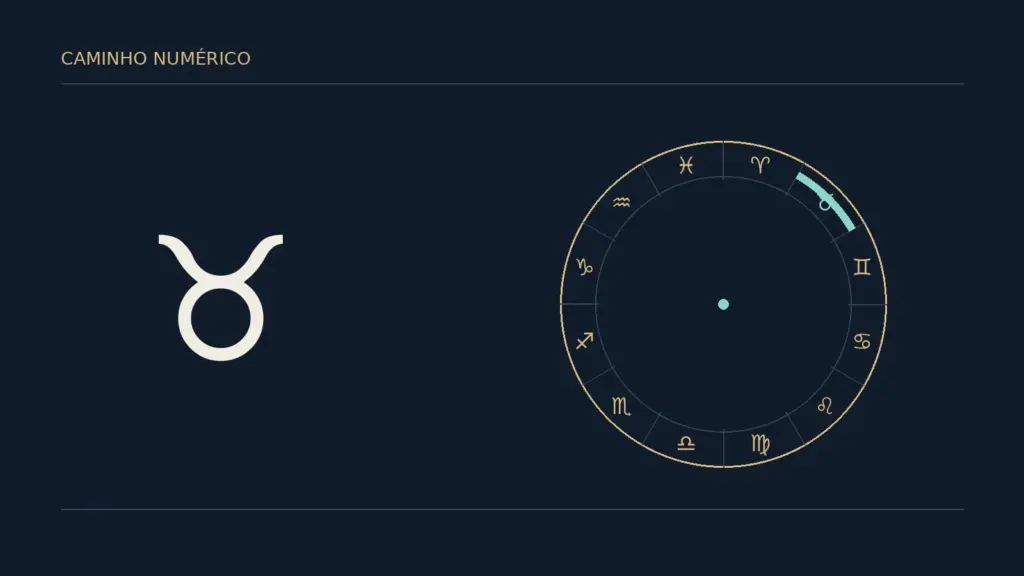
The Taurus sign covers approximately the dates from 20 April to 20 May in the tropical zodiac, a system of 12 sectors of 30 degrees each, based on the apparent position of the Sun in relation to the Earth throughout the year.
Element, modality and symbolic rulership
Taurus belongs to the Earth element, which in tradition is associated with concretisation, solidity and contact with the material world. Its modality is fixed, indicating a tendency towards persistence, the maintenance of what is already established and resistance to sudden changes in the immediate environment. The symbolic rulership is attributed to Venus, which in this context represents the astrological language related to value, attachment to what is appreciated and the search for harmony in relationships and surroundings.
Interpretive theme: constancy and comfort
In tradition, the Taurus sign is interpreted through the theme of constancy and comfort. This does not mean that all people with the Sun in Taurus are the same, but that the symbol points to an explorable inclination: the desire to create stable bases, to enjoy what is tangible and pleasant, and to build routines that bring a sense of security. This association is made as a form of question, not as an assertion about capabilities or future.
Difference between sign and constellation
It is important to distinguish the Taurus sign from the constellation of Taurus. The tropical zodiac divides the ecliptic into 12 equal parts, regardless of the actual boundaries of the astronomical constellations. Therefore, the sign does not correspond exactly to the current position of the constellation of Taurus in the sky, but to a symbolic sector based on the seasons of the year in the northern hemisphere.
Sun, Moon and Ascendant: different fields
The sun sign (Taurus, in this case) refers only to the position of the Sun in the birth chart at the moment of birth. It does not describe the entire personality. The birth chart includes other fields, such as the Moon (related, in tradition, to the inner world and emotional responses) and the Ascendant (the sign that was rising on the eastern horizon, associated with the way the person presents themselves to the world). Each of these fields has a distinct symbolic function and must be interpreted separately.
Dates of the Sun’s entry and boundaries
The dates of the Sun’s entry into Taurus vary slightly from year to year and depend on the time zone. Anyone born on a boundary (for example, 20 April or 20 May) needs to know the year, the exact time and the place of birth to correctly determine the sun sign. One should never state that someone has two simultaneous sun signs: the Sun occupies only one position in the zodiac at any moment.
Concrete exercise: try a small change
A practical, non-prescriptive suggestion for those exploring the symbol of Taurus is to try a small change in a routine that already works. For example, alter the route to work, swap a mealtime or introduce a new element into a habitual task. The aim is not to change everything, but to observe how one feels when introducing a slight variation into a stable pattern, using the experience as a way to reflect on the balance between constancy and adaptation.
Difficulty suggested by tradition
According to tradition, a difficulty associated with the symbol of Taurus may be confusing stability with resistance to change. This is not a diagnosis, but a symbolic association that can be used as a question: in which situations can the search for security lead to maintaining patterns that no longer serve? The exercise above helps to explore this dynamic in a practical and personal way.
Compatibility as a comparison exercise
In the context of tradition, compatibility between signs can be approached as an exercise in comparing communication styles and symbolic needs. For example, Taurus (Earth, fixed) can be contrasted with Leo (Fire, fixed) or Scorpio (Water, fixed), observing how the fixed modalities manifest in different elements. No rankings, certainties or percentages are attributed, and the sign is not associated with fidelity, morality or success in relationships as proven facts.
Differentiation from other Earth signs
Within the Earth element, Taurus differs from Virgo (mutable) and Capricorn (cardinal) by its fixed modality and the theme of constancy and comfort. While Virgo may be associated, in tradition, with adaptation through analysis and adjustment, and Capricorn with construction through effort oriented towards goals, Taurus emphasises the maintenance of what is valid and the appreciation of the material present.
Rulership and luminaries
Venus is an astronomical planet. Its rulership of Taurus is a convention of astrological language, not a demonstrated physical influence on personality. The Sun and Moon are luminaries (not astronomical planets) and have distinct roles in the birth chart: the Sun represents the central principle identified with active consciousness, while the Moon is associated, in tradition, with the inner world and habitual responses. None of these fields reveals innate qualities or future.
Contextual internal links
To deepen the study of the signs, consult the guide to the 12 Zodiac Signs: Complete Astrology Guide. To understand how the Earth element relates to the others, see the page on Water, Fire, Earth and Air Signs: Characteristics of the 4 Elements. If you want to know more about the Ascendant and its role in the birth chart, read the article on Ascendant: What It Is, How to Calculate and the Meaning of Each Sign. Finally, to interpret the set of planetary positions, consult the guide on Birth Chart: What It Is and How to Interpret Yours.
Comparative table: Taurus and other fixed signs
| Sign | Element | Interpretive theme (tradition) |
|---|---|---|
| Taurus | Earth | Constancy and comfort |
| Leo | Fire | Creative expression and recognition |
| Scorpio | Water | Transformation through emotional depth |
| Aquarius | Air | Innovation through detachment from pattern |
This table shows how the fixed modality manifests in different elements, according to symbolic associations of tradition. There is no hierarchy or implied value in the order of the signs.
The dates, elements and modalities follow the conventions of the tropical zodiac presented in the Astrology.com signs guide. This reference describes an interpretive tradition; it does not demonstrate individual characteristics.
Caminho Numérico
Keep exploring numerology
Get new articles on numerology, tarot and astrology to explore the ideas in this article further.