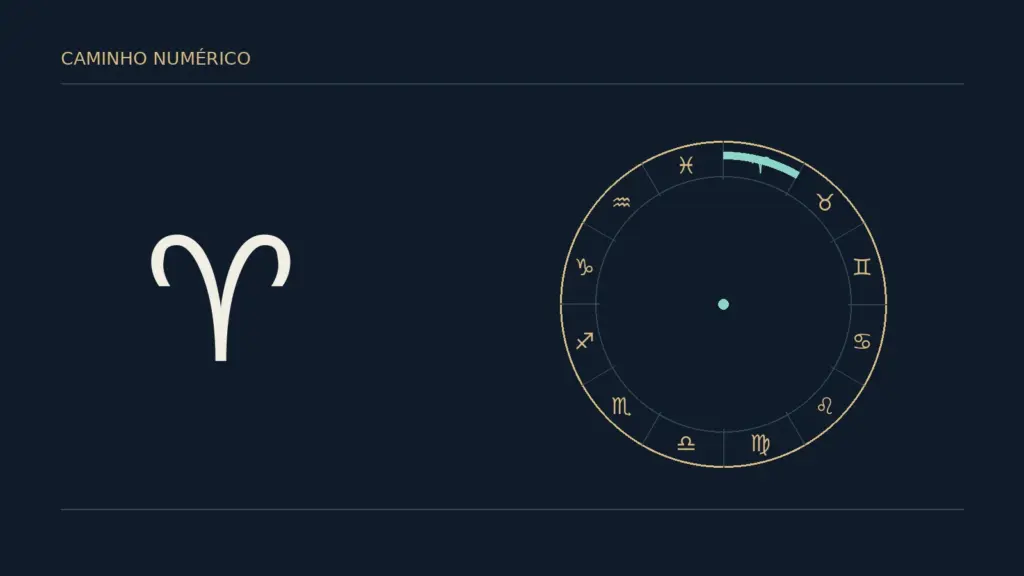
The Aries sign covers approximately from 21 March to 19 April in the tropical zodiac, a system of 12 sectors of 30 degrees based on the apparent position of the Sun relative to the Earth. These dates are approximate because the exact moment of the Sun’s entry into the sector varies slightly with the year and the birth time zone. Anyone born on a cusp needs to know the exact year, time and place of birth to determine the correct sun sign, as it is not possible to have two simultaneous sun signs.
Symbolic characteristics of Aries
In the astrological tradition, Aries is associated with the Fire element and cardinal modality. The Fire element refers to energy, enthusiasm and the impulse to act. The cardinal modality indicates a principle of beginning, an impulse to initiate cycles. Together, these factors give rise to the interpretive theme of initiative and impulse, often linked to the desire to start something new, to take the lead or to respond quickly to stimuli.
The symbolic rulership of Mars reinforces this association with direct action, courage and the impulse to overcome obstacles. Mars, in this symbolic context, is not treated as an astronomical planet with physical influence, but as an archetype representing the energy of departure, the impulse to assert oneself in the world.
Differences within the Fire element
Although it shares the Fire element with Leo and Sagittarius, Aries is distinguished by its cardinal modality. Leo is fixed, associated with sustenance and stable creative expression; Sagittarius is mutable, linked to adaptation and the exploration of horizons. Aries, as cardinal, has a more pronounced focus on the initiation of actions, the impulse to take the first step, while Leo may concentrate on maintaining the shine of an already started project and Sagittarius on adapting to new experiences along the way.
Initiative and impulse in symbolic reading
The theme of initiative and impulse suggests a tendency to act quickly when faced with an opportunity or challenge. In the tradition, this energy can lead to enthusiastic starts, but also to suggested difficulties such as acting before listening or before gathering sufficient information. This is not a statement about capabilities or fixed behaviour, but a symbolic association that can be used as a point of reflection.
Concrete exercise
As a way to explore this energy in a balanced manner, you can try the following exercise: when starting a task, combine a short pause before responding to external stimuli or making important decisions. For example, if you start writing a report, after 20 minutes of focused work, take a five-minute pause to breathe and observe before continuing or replying to a message. This exercise is not a prescription, but a way of using the Aries symbol as a question: how can I start with energy and still keep space to listen?
Sun, Moon and Ascendant: different fields
It is important to distinguish the sun sign (determined by the position of the Sun at the moment of birth) from the moon sign (position of the Moon) and the Ascendant (the sign rising on the eastern horizon). Each represents a different symbolic field in the birth chart: the Sun is usually associated with conscious identity and the impulse of expression; the Moon with the inner world and emotional needs; the Ascendant with how you initially present yourself to the world. The sun sign alone does not describe the whole birth chart, which also includes the positions of other symbolic points and the relationships between them.
Compatibility as a comparison exercise
In the tradition, compatibility between signs can be explored as an exercise in comparing communication styles and symbolic needs. For example, Aries, with its focus on initiative and impulse, can reflect on how its energy of starting quickly relates to that of other signs. An Earth sign like Taurus (fixed) can bring a symbolic association with sustenance and patience, offering a useful contrast for reflection on different rhythms. An Air sign like Gemini (mutable) can be linked to adaptation and the exchange of ideas, suggesting another point of comparison. These exercises do not involve rankings, certainties or percentages, but serve as a way to explore how different symbolic energies can interact in communication exchanges or joint projects.
Guides to continue study
To deepen your understanding of the Aries sign in the broader context, you can consult the guide to the 12 Zodiac Signs: Complete Astrology Guide, which offers an overview of all the signs. To better understand the role of the Fire element, visit the page on Water, Fire, Earth and Air Signs: Characteristics of the 4 Elements. If you want to know how the Ascendant influences how you present yourself to the world, see the article on Ascendant: What It Is, How to Calculate and the Meaning of Each Sign. Finally, to understand how the sun sign fits into the complete birth chart, explore the guide on Birth Chart: What It Is and How to Interpret Yours.
Limits of symbolic interpretation
The characteristics described here are associations of the astrological tradition, not proven facts about people. There is no evidence that the sun sign determines professions, gender, morality, health or fidelity. The tropical zodiac is a symbolic system of 12 sectors of 30 degrees, distinct from the astronomical constellations with the same names. The Sun and Moon are luminaries in astrological language, not astronomical planets, and their rulership is a symbolic convention. You should not associate the sign with fixed traits or use these descriptions to draw conclusions about yourself or others.
The dates, elements and modalities follow the conventions of the tropical zodiac presented in the Astrology.com zodiac signs guide. This reference describes an interpretive tradition; it does not demonstrate individual characteristics.
Caminho Numérico
Keep exploring numerology
Get new articles on numerology, tarot and astrology to explore the ideas in this article further.