To start applying feng shui, choose one room, sketch its floor plan and examine the entrance, walking routes and furniture. Tidy, repair and test reversible changes before adding decorations. This guide uses an entrance-aligned Bagua (BTB method) and explains Chi and the five elements as traditional concepts, without promises of health or prosperity.
What Is Feng Shui?
Feng shui is a Chinese tradition for interpreting and arranging spaces. It uses concepts such as Chi, Yin and Yang, the five elements and Bagua. Schools differ in how they orient the map and interpret a site.
Some suggestions overlap with practical organisation, such as clear routes and suitable lighting. That overlap does not establish that objects or colours produce health or financial outcomes.
Chi: The Vital Energy
Chi, or Qi, refers to vital energy in the tradition. An “obstruction” in this context is a symbolic interpretation, not a physical measurement or diagnosis. Make the exercise concrete by looking for things that prevent use of the room: blocked doors, awkward furniture, crowded surfaces or insufficient task lighting.
The Five Elements
Feng Shui organises all energy into five elements that interact with each other in cycles of creation and control:
| Element | Represents | Colours | Shapes | Materials |
|---|---|---|---|---|
| Wood | Growth, vitality | Green, brown | Rectangular, vertical | Wood, plants |
| Fire | Passion, transformation | Red, orange, pink | Triangular, pointed | Candles, lighting |
| Earth | Stability, nourishment | Yellow, beige, brown | Square, flat | Ceramics, stone |
| Metal | Precision, clarity | White, grey, gold | Round, oval | Metal, minerals |
| Water | Fluidity, wisdom | Black, dark blue | Wavy, irregular | Water, mirrors, glass |
The creation cycle: Wood feeds Fire → Fire creates Earth (ashes) → Earth contains Metal → Metal conducts Water → Water nourishes Wood.
The elements are symbolic categories within this tradition. You can explore colours and materials without treating them as a formula that determines well-being. A room still needs to serve the people using it.
The Bagua Map for Beginners
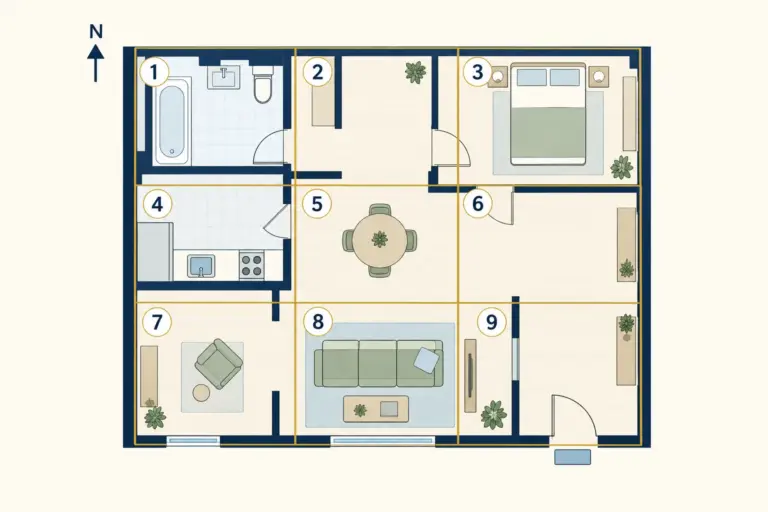
The Bagua can be represented as a three-by-three grid. This guide follows the entrance-aligned BTB approach:
- Sketch the room’s outline and mark doors and windows.
- View the plan as though standing at the entrance, facing inside.
- Place the base of the grid along that entrance side.
- Divide the plan into three rows and three columns.
- Explore the symbolic associations while keeping access functional.
This grid does not identify geographic north. The International Feng Shui Guild glossary distinguishes BTB from compass methods. See the comparison in our home Bagua guide.
5 First Steps to Apply Feng Shui
- Choose one room: identify a concrete problem, such as a blocked route.
- Organise what you need: give useful objects a place and remove obstacles.
- Address defects: deal with sticking doors, leaks or missing lighting using appropriate help.
- Test the layout: move only what you can handle safely. For a bedroom, see our bed placement guide.
- Reassess: after using the room, note what became easier and what still needs adjusting.
Common Beginner Mistakes
- Mixing an entrance-aligned Bagua with a compass-direction table.
- Buying charms before fixing a blocked route or a defect.
- Copying a layout that does not fit your room.
- Treating a symbolic rule as a guarantee of money, health or harmony.
If you are interested in accessories, our feng shui bracelet guide explains their meaning and material care.
Frequently Asked Questions
What is Feng Shui and how does it work?
Feng Shui is a Chinese tradition that interprets spaces through concepts such as Chi and the five elements. It proposes arrangements of furniture, colours and natural elements. Its claims about energy, health and prosperity belong to that tradition; this guide does not present them as demonstrated effects.
Where to start applying Feng Shui?
Start by tidying and letting go of objects you do not use. Then fix everything that is broken, light the entrance of the home and position the bed and sofa in the “command position” (with wall behind and view of the door).
Does Feng Shui really work?
Organising a room, maintaining it and keeping circulation paths clear are practical changes you can assess in your own home. That does not establish an effect of Chi or a guarantee of health or prosperity. The energetic aspect is a matter of personal belief.
What are the 5 elements of Feng Shui?
Wood (growth), Fire (passion), Earth (stability), Metal (clarity) and Water (fluidity). The balance of these five elements in each space is fundamental for harmony in Feng Shui.
Conclusion
Start with a small change and assess how the space works in daily use. Continue with the guides to bedroom layout, each room of the home and couples’ bedrooms.
Housing and health: a separate reference
The WHO Housing and health guidelines address evidence on housing conditions and safety. They are a reference for physical housing conditions, not evidence for Feng Shui energy claims.
Caminho Numérico
Keep exploring numerology
Get new articles on numerology, tarot and astrology to explore the ideas in this article further.