What are chakras, really?
You’ve probably felt it before — that tightness in your chest when anxiety hits, or the pit in your stomach before a tough conversation. Whether you knew it or not, you were experiencing your chakras at work. Chakras are energy centres in the body, described thousands of years ago in Hindu and Buddhist traditions, and they function as focal points where vital energy (prana) gathers and flows.
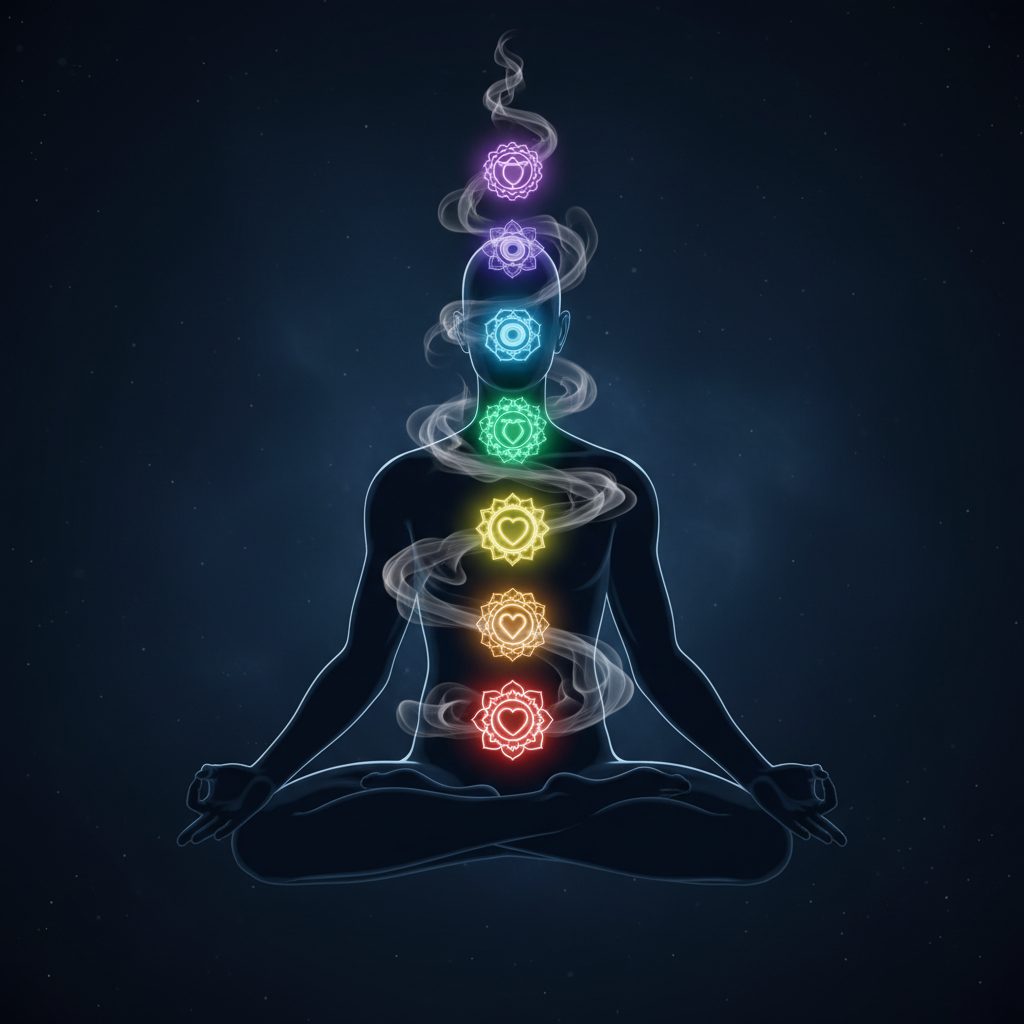
The word “chakra” comes from Sanskrit and means “wheel” or “disc.” Picture seven spinning wheels of energy aligned along your spine, from the base all the way up to the crown of your head. Each one vibrates at its own frequency, has a colour associated with it, and influences specific areas of your life — from survival instincts to spiritual connection.
When these centres are balanced, energy moves freely and you feel good: physically, emotionally, and mentally. When there are blockages, things start to go sideways. Emotional exhaustion, trouble communicating, creative blocks… in this tradition, it can all be read as a sign of imbalance. Physical pain or persistent anxiety, though, is a matter for your doctor or psychologist.
In this guide, we’ll walk through each of the 7 main chakras, from the first to the seventh. For each one, you’ll discover where it’s located, what it governs, how to spot blockages, and — most importantly — how to restore balance.
1. Root Chakra (Muladhara) — Your Foundation
Location: Base of the spine, at the perineum
Colour: Red
Element: Earth
Mantra: LAM
The Muladhara is the foundation of the entire system. It’s connected to your most basic instincts: survival, safety, financial stability, and your connection to the earth. This is the chakra that keeps you grounded — quite literally.
When the root chakra is balanced, you feel safe. You trust that your basic needs are covered. There’s a sense of belonging and stability that allows you to face challenges without spiralling into panic.
Signs of blockage
Constant anxiety with no apparent cause. Excessive fear — of losing your job, running out of money, not having a roof over your head. Tradition also links this chakra to the legs, feet and lower back. Chronic fatigue and a feeling of being ungrounded — as if you’re floating, disconnected from reality — are also common.
How to balance it
Meditation: Sit with your feet flat on the ground. Visualise an intense red light at the base of your spine, expanding and rooting you into the earth. Repeat the mantra LAM quietly.
Crystals: Red jasper, black obsidian, hematite. Place them near your body during meditation or carry them in your pocket throughout the day.
Food: Red and root vegetables — beetroot, tomatoes, red berries, potatoes, carrots, ginger. Protein-rich foods that create a sense of fullness also help.
Practical exercise: Walk barefoot on grass or soil for 10-15 minutes. Sounds too simple? Try it first. The sense of connection to the ground is almost immediate.
2. Sacral Chakra (Svadhisthana) — Creativity and Pleasure
Location: About 5 cm below the navel
Colour: Orange
Element: Water
Mantra: VAM
The second chakra governs emotions, sexuality, creativity, and pleasure. This is where your ability to feel is born — joy, desire, enthusiasm. It’s also the centre of your emotional and intimate relationships with others.
When it’s functioning well, you can surrender to pleasurable experiences without guilt, express emotions in a healthy way, and maintain balanced relationships. Creativity flows naturally.
Signs of blockage
Creative blocks, lack of motivation, difficulty feeling pleasure or joy. There may be intimacy issues — either emotional withdrawal or excessive dependency on a partner. Tradition also links this chakra to the lower abdomen. Emotional rigidity is another clear indicator.
How to balance it
Meditation: Focus on the area below your navel. Imagine an orange sphere, warm and fluid, like gentle lava. Let it expand with each breath. The mantra VAM helps activate this zone.
Crystals: Carnelian, moonstone, amber. Carnelian is particularly effective — it’s known as the “stone of creativity.”
Food: Oranges, mangoes, carrots, pumpkin seeds, honey, cinnamon. Water-rich foods — watermelon, cucumber — also resonate with this chakra.
Practical exercise: Dance. No choreography, no judgement, no mirror. Put on music you enjoy and let your body move however it wants for 10 minutes. Hip movements are especially effective.
3. Solar Plexus Chakra (Manipura) — Personal Power
Location: Stomach area, between the navel and sternum
Colour: Yellow
Element: Fire
Mantra: RAM
Ever heard the phrase “gut feeling”? That’s not a coincidence. The third chakra is the centre of personal power, self-esteem, and willpower. This is where your sense of “self” lives — your identity, your confidence, your ability to act in the world.
When it’s strong, you feel capable. You make decisions with clarity, you don’t let others manipulate you, and you have the drive to pursue your goals.
Signs of blockage
Low self-esteem, indecisiveness, feelings of helplessness. Or the opposite — a need to control everything and everyone, aggression, inflated ego. In the body, tradition links it to the stomach area. That knot in your stomach before stressful situations is a classic sign of an unbalanced Manipura.
How to balance it
Meditation: Imagine a golden-yellow flame in the centre of your abdomen. Strong, steady, warm. With each inhale, the flame grows. Repeat the mantra RAM.
Crystals: Citrine, tiger’s eye, pyrite. Citrine is especially powerful — it’s often called the “success stone.”
Food: Bananas, pineapple, corn, oats, turmeric, ginger, chamomile tea. Yellow and warming foods.
Practical exercise: Core exercises or yoga focused on the midsection (plank, navasana). But there’s something subtler that works remarkably well: set one small goal for the day and complete it. It can be simple — organise a drawer, make that phone call you’ve been putting off. Every small victory feeds your third chakra.
4. Heart Chakra (Anahata) — Love and Compassion
Location: Centre of the chest
Colour: Green (and pink)
Element: Air
Mantra: YAM
Anahata is the balancing point of the entire system — it bridges the three lower chakras (more physical) with the three upper chakras (more spiritual). It’s the centre of unconditional love, compassion, forgiveness, and acceptance.
When open, you love without conditions. You forgive (yourself and others), feel genuine empathy, and maintain healthy relationships. There’s a lightness in the chest, a sense of openness.
Signs of blockage
Difficulty forgiving, bitterness, jealousy, loneliness even when surrounded by people. Fear of being emotionally vulnerable. It can also manifest as emotional dependency — giving too much of yourself without receiving, or shutting down entirely. Physically, tradition links it to the chest, shoulders and arms — any real heart or breathing symptoms need a doctor.
How to balance it
Meditation: Place your hand on the centre of your chest. Feel your heartbeat. Imagine an emerald green light radiating from your chest, enveloping you completely. Repeat YAM.
Crystals: Rose quartz, green aventurine, malachite, jade. Rose quartz is the classic — the “stone of love.”
Food: Green leafy vegetables — spinach, kale, broccoli. Green tea, avocado, kiwi. Herbs like mint and basil.
Practical exercise: Practise one genuine act of kindness every day for a week. It doesn’t need to be grand — a sincere compliment, helping someone with their shopping, writing a thank-you message. It sounds cliché, I know, but the effects on the heart chakra are very real.
5. Throat Chakra (Vishuddha) — Expression and Truth
Location: Throat
Colour: Light blue
Element: Ether/Space
Mantra: HAM
The fifth chakra is the centre of communication, self-expression, and truth. It’s not just about talking — it includes listening, writing, singing, any form of authentic expression. It’s through Vishuddha that you communicate who you really are to the world.
When balanced, you communicate with clarity and authenticity. You can say what you think without being aggressive, you listen to others attentively, and you express your creativity fluidly.
Signs of blockage
Fear of public speaking, difficulty voicing opinions, feeling like you “swallow” what you want to say. Frequent lying — including to yourself. Or the reverse: talking too much, interrupting, inability to listen. In the body: tradition links it to the throat, neck and jaw.
How to balance it
Meditation: Focus on your throat. Imagine a sky-blue light pulsing in that area, clearing any tension. The mantra HAM vibrates at exactly the right frequency.
Crystals: Lapis lazuli, sodalite, turquoise, aquamarine. Lapis lazuli is particularly powerful for unblocking communication.
Food: Blueberries, blackberries, figs, honey, herbal teas (especially chamomile and peppermint). Liquids in general — keeping the throat hydrated is essential.
Practical exercise: Sing. In the shower, in the car, home alone — it doesn’t matter if you’re off-key. The act of singing opens and activates the throat chakra like few other exercises can. If singing isn’t your thing, try journaling — writing your thoughts without a filter for 10 minutes.
6. Third Eye Chakra (Ajna) — Intuition and Inner Vision
Location: Between the eyebrows
Colour: Indigo (dark blue)
Element: Light
Mantra: OM (or SHAM)
Ajna is the centre of intuition, perception, and inner vision. This is where your ability to “see beyond” resides — not in some Hollywood-mystical sense, but in the genuine capacity to notice patterns, trust your gut, and access a deeper understanding of situations.
When active and balanced, your intuition is strong. You make decisions that “feel” right, you have mental clarity, and you can see situations from multiple perspectives. Vivid dreams and moments of spontaneous insight are signs of a healthy third eye.
Signs of blockage
Mental confusion, difficulty making decisions, disconnection from intuition. You may feel “lost” — without a clear direction in life. Excessive rationalism and refusal to consider anything beyond the tangible is also telling. Physically: tradition links it to the forehead and eyes.
How to balance it
Meditation: With your eyes closed, direct your attention to the space between your eyebrows. You might feel a slight pressure — that’s normal. Imagine an indigo eye slowly opening. The mantra OM is the most universal and powerful for this chakra.
Crystals: Amethyst, fluorite, labradorite. Amethyst is the queen of intuition and spirituality — many people keep one on their bedside table as part of their evening ritual.
Food: Purple and dark blue foods — blueberries, black grapes, aubergine, plums. Dark chocolate (in moderation!). Teas such as lavender and passionflower.
Practical exercise: Before making a decision, pause. Close your eyes. Ask yourself “what do I feel about this?” and listen to the first answer that comes — before your rational brain drowns it out. Practise this with small daily decisions and watch your intuition sharpen over time.
7. Crown Chakra (Sahasrara) — Spiritual Connection
Location: Top of the head
Colour: Violet or white
Element: Thought/Consciousness
Mantra: OM (or silence)
Sahasrara is the final chakra and the most subtle. It connects you to the divine, the universe, the collective consciousness — call it what you will. It’s not tied to any specific religion; it’s simply the point of connection to something greater than yourself.
When open, you feel a deep peace. There’s a sense of purpose, an understanding that you’re part of something larger. This isn’t spiritual arrogance — it’s more of a quietness, an acceptance.
Signs of blockage
Existential emptiness, extreme cynicism, spiritual disconnection, the feeling that “life has no meaning.” The opposite can also occur — spiritual obsession, spiritual bypassing (using spirituality to avoid dealing with real problems). In the body: tradition links it to the top of the head.
How to balance it
Meditation: Silent meditation is the most powerful tool for the seventh chakra. Sit in silence, no mantra, no visualisation. Just observe. Let thoughts pass like clouds. With practice, moments of absolute stillness begin to emerge — and in those moments, Sahasrara opens.
Crystals: Clear quartz, amethyst, selenite, howlite. Selenite is particularly recommended — it’s said to cleanse the energy of all chakras simultaneously.
Food: This chakra responds less to physical food and more to conscious fasting or a light, clean diet. Lavender tea, lemon water, organic foods. Some practitioners recommend intermittent fasting as a way to "clear" the spiritual connection. It isn't for everyone; if in doubt, talk to your doctor.
Practical exercise: Spend time in nature without your phone. Seriously, without your phone. Go somewhere quiet — a forest, a beach at sunrise, a garden — and just be there. No agenda, no purpose. Just being. Twenty minutes is enough to feel the difference.
How to tell which chakra needs attention
There’s no magic formula, but there are clues. Notice your patterns:
- Financial problems or constant fear? — Root Chakra
- Creative blocks or intimacy issues? — Sacral Chakra
- Low self-esteem or a knot in the stomach? — Solar Plexus
- Difficulty loving or forgiving? — Heart Chakra
- Can’t express what you feel? — Throat Chakra
- Mental confusion or lack of intuition? — Third Eye
- Existential emptiness or disconnection? — Crown Chakra
Often, more than one chakra is out of balance — and that’s perfectly normal. The suggestion is to start from the bottom up. Balancing the root chakra first creates the foundation for the rest.
A simple daily practice to balance all chakras
If you want something quick and effective, try this 15-minute routine:
- Minutes 1-2: Sit comfortably. Three deep breaths to settle in.
- Minutes 3-9: Move through each chakra from bottom to top. Visualise the corresponding colour at each point. Spend about 1 minute on each. Don’t force it — just observe.
- Minutes 10-12: Imagine a white light travelling up your entire spine, from your feet to the top of your head, cleansing and harmonising.
- Minutes 13-15: Return to the present moment. Wiggle your fingers, open your eyes slowly. Drink a glass of water.
It doesn’t need to be perfect. You don’t need to see vivid colours or feel extraordinary sensations. Consistency is what matters — doing a little every day beats one epic session once a month.
The chakras and the number 7
It’s no coincidence that there are 7 main chakras. The number 7 appears throughout spiritual traditions: 7 days of the week, 7 musical notes, 7 colours of the rainbow. In numerology, 7 is the number of spirituality, introspection, and the search for inner truth — exactly what chakra work represents.
If your life path number or personal year in numerology is connected to 7, working with chakras may be particularly meaningful for you. It’s as if the universe is nudging you toward that inner exploration.
Final thoughts
Working with chakras isn’t an instant fix for all of life’s problems. It won’t replace a doctor when you need one, or resolve complex issues overnight. But it is a powerful tool for self-awareness.
By paying attention to your energy centres, you start noticing patterns that previously went undetected. You understand better why you react in certain ways, why certain areas of life always seem difficult, and what you can do to change that.
Start slowly. Pick one chakra — the one that resonates most with you right now — and dedicate a week to it. Try the exercises, the crystals, the food suggestions. Notice what shifts, even subtly. Then move on to the next.
Energy is constantly in motion. Your chakras don’t need to be “perfect” — they need attention. And that, fortunately, is entirely in your hands.
Caminho Numérico
Keep exploring numerology
Get new articles on numerology, tarot and astrology to explore the ideas in this article further.