What Exactly Is a Birth Chart?
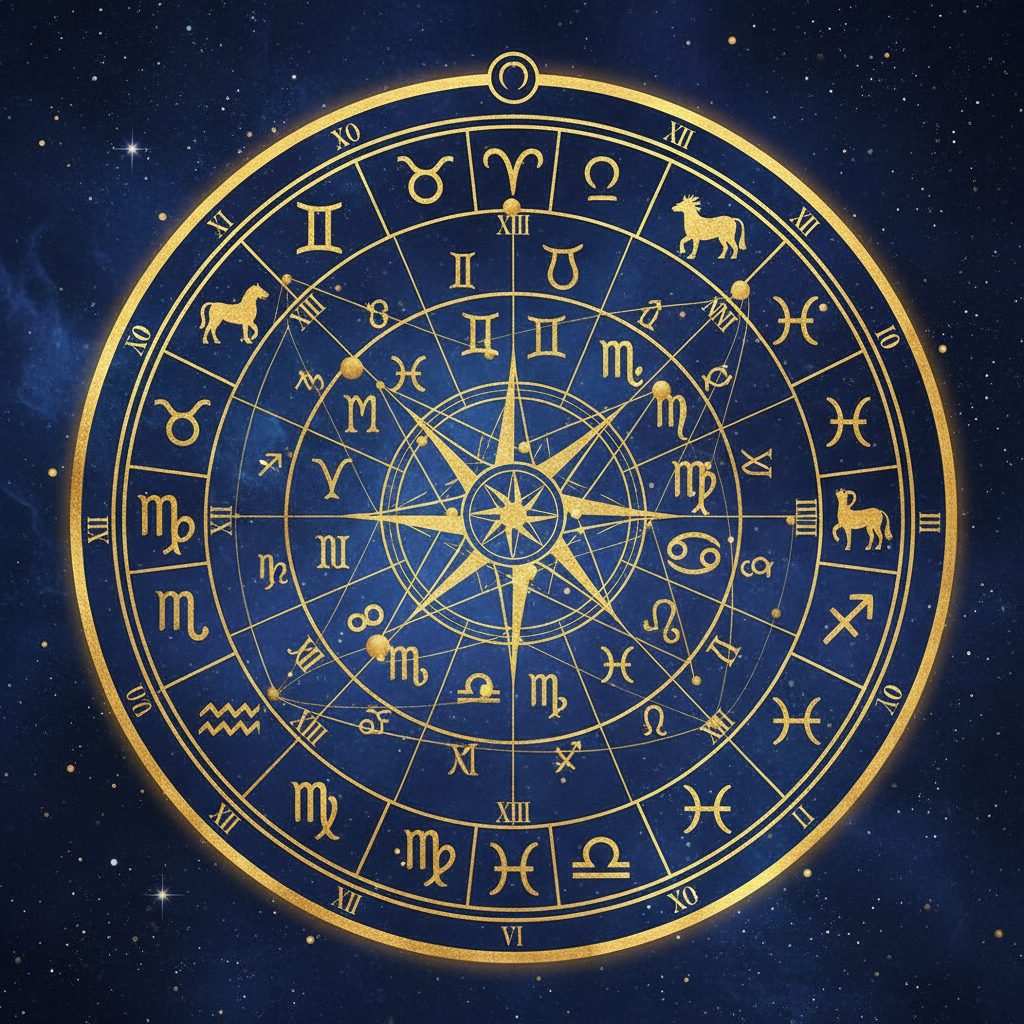
Ever read your horoscope and thought “this doesn’t sound like me at all”? There’s a good reason for that. Your sun sign — the one everyone knows — is just one piece of a much larger puzzle. That puzzle is called a birth chart (also known as a natal chart), and it’s essentially a snapshot of the sky at the precise moment you were born.
Picture the sky divided into 12 slices, with planets scattered across each of them, each one telling a different part of your story. The Sun might be in Leo, the Moon in Pisces, Venus in Scorpio — and each of those placements shapes different aspects of your personality, relationships, and the way you move through the world.
A birth chart isn’t a prediction of the future. Think of it more like an instruction manual — except it’s about you. It reveals your natural tendencies, your strengths, the challenges you’re likely to face, and even the kind of relationships you tend to attract.
The Big Three: Sun, Moon, and Rising
If there are three things you should know about your birth chart, it’s these: your Sun, your Moon, and your Rising sign (Ascendant). Together, they form what astrologers often call the astrological “trinity” — the foundation of who you are.
The Sun — Your Core Self
The Sun represents your deepest self, your central identity. It’s what drives you, what makes you feel alive. When someone asks “what’s your sign?”, they’re asking about your Sun sign.
But here’s the thing — the Sun is who you are, not necessarily who you appear to be. Someone with their Sun in Cancer might come across as cold and distant at first glance (depending on their rising sign), but inside they’re pure sensitivity.
The Moon — Your Emotional World
The Moon governs emotions, instincts, and what you need to feel safe. It’s the part of you that shows up when you’re at home in your pyjamas, no social mask on.
Your Moon placement says a lot about how you process feelings. A Moon in Gemini processes emotions by talking — they need to verbalise everything. A Moon in Taurus needs physical comfort, a warm cup of tea, and a soft sofa. A Moon in Aries reacts first and thinks later.
The Ascendant — Your Social Mask
The Ascendant (or rising sign) is the sign that was rising on the eastern horizon at the exact moment of your birth. That’s why you need to know your birth time to calculate it accurately.
Your rising sign determines how you present yourself to the world and the first impression you make. It works almost like an outer layer — it’s not fake, it’s genuinely part of you, but it’s the part others see first.
Someone with a Virgo Sun and Sagittarius Rising might seem adventurous, relaxed, and even a bit impulsive — but internally they’re analysing every last detail.
The 12 Astrological Houses
Now let’s talk about those 12 slices of the sky I mentioned earlier. They’re called astrological houses, and each one governs a different area of life. Think of them as stages — and the planets as actors performing on each stage.
1st House (Ascendant): Your identity, appearance, and how you present yourself. The house of “self.”
2nd House: Money, material possessions, and personal values. What you value — literally and figuratively.
3rd House: Communication, siblings, short trips, and everyday thinking. How you speak, write, and process information.
4th House (IC): Home, family, roots, and private life. Your inner sanctuary.
5th House: Creativity, romance, children, and pleasure. Everything you do for fun and self-expression.
6th House: Daily work, health, routines, and service to others. Your practical day-to-day.
7th House (Descendant): Serious relationships, partnerships, and marriage. The “other” — what you seek in a partner.
8th House: Transformation, sexuality, inheritances, and the occult. The house of crises that lead to growth.
9th House: Philosophy, long-distance travel, higher education, and spirituality. The search for meaning.
10th House (Midheaven): Career, public reputation, and ambitions. How the world sees you professionally.
11th House: Friendships, groups, social causes, and future dreams. Your tribe.
12th House: The subconscious, isolation, deep spirituality, and secrets. What you hide — even from yourself.
Not every house will have planets in it — and that’s perfectly normal. It doesn’t mean those life areas don’t exist for you; they simply don’t carry the same emphasis or intensity.
Personal Planets vs. Generational Planets
Here’s an important distinction that many people overlook. In a birth chart, not all planets carry the same personal weight.
Personal Planets (Fast-Moving)
These move quickly through the zodiac, so their position varies significantly from person to person:
- Sun — Identity and purpose (~1 month per sign)
- Moon — Emotions and instincts (~2.5 days per sign)
- Mercury — Communication and reasoning (~3 weeks per sign)
- Venus — Love, beauty, and values (~4 weeks per sign)
- Mars — Action, energy, and desire (~6 weeks per sign)
These are the ones that most define your individual personality. Two people born in the same month can have Moons in completely different signs — and that makes all the difference.
Social Planets
- Jupiter — Expansion, luck, and beliefs (~1 year per sign)
- Saturn — Discipline, responsibility, and lessons (~2.5 years per sign)
Jupiter and Saturn are shared with more people — everyone born in the same year will have Jupiter in the same sign, for instance. Still, the house they fall in within your chart makes a difference.
Generational Planets (Slow-Moving)
- Uranus — Revolution and originality (~7 years per sign)
- Neptune — Dreams, illusion, and spirituality (~14 years per sign)
- Pluto — Deep transformation and power (~12-31 years per sign)
These planets define entire generations. Everyone born between, say, 1995 and 2008 has Pluto in Sagittarius. The sign placement is less personal — but the house and aspects they form in your individual chart still matter.
How to Get Your Birth Chart for Free
Good news: you don’t need to pay anything to see your birth chart. Several online platforms calculate it in seconds. You’ll need three pieces of information:
- Date of birth (day, month, and year)
- Time of birth (as precise as possible — check your birth certificate)
- Place of birth (the city where you were born)
The birth time is crucial. A difference of half an hour can change your Ascendant and shift entire house placements. If you don’t know your time, check your birth certificate or hospital records.
Some recommended sites to generate your chart:
- Astro.com — the most comprehensive and respected among professional astrologers
- Astro-Charts.com — more modern visual design, easy to use
- CaféAstrology.com — great for beginners, with interpretations included
On any of these, you enter your data and receive an astrological wheel with all planet positions, houses, and aspects.
How to Read Your Chart Positions
When you first look at a birth chart, it seems like a complicated diagram full of strange symbols. Don’t panic — let’s break it down.
Each position in the chart follows this logic: Planet + Sign + House. For example, “Venus in Libra in the 7th House” means your love and relationship energy (Venus) expresses itself diplomatically and harmoniously (Libra), and is focused on the area of partnerships (7th House). Makes sense, right?
Another example: “Mars in Aries in the 10th House.” Your action and ambition energy (Mars) is direct and competitive (Aries), and it manifests in your career (10th House). Someone with this placement probably doesn’t rest until they’ve reached the top professionally.
The trick is to go position by position, without trying to understand everything at once. Start with the Sun, Moon, and Ascendant. Then explore Mercury, Venus, and Mars. Only after that should you dive into the slower planets.
The Signs and Their Elements
Each sign belongs to an element, and this helps you quickly grasp its energy:
Fire (Aries, Leo, Sagittarius): Impulse, passion, action. Planets in Fire signs are expressive and energetic.
Earth (Taurus, Virgo, Capricorn): Practicality, stability, manifestation. Planets in Earth signs are realistic and steady.
Air (Gemini, Libra, Aquarius): Ideas, communication, sociability. Planets in Air signs are intellectual and relational.
Water (Cancer, Scorpio, Pisces): Emotion, intuition, depth. Planets in Water signs are sensitive and perceptive.
If you have many planets in Water signs, for instance, you’re probably a highly intuitive and emotional person — even if your Sun sign is in Earth.
Aspects: How Planets Talk to Each Other
This is the part that transforms a birth chart from a list of positions into a coherent story. Aspects are angles that planets form with each other, and they determine how their energies combine.
There are many types of aspects, but let’s focus on the three most important ones:
Conjunction (0°)
When two planets are at the same degree (or very close), their energies merge. This can be brilliant or challenging, depending on which planets are involved.
Sun conjunct Venus? Natural charm and an easy ability to attract others. Mars conjunct Saturn? Immense determination, but also frustration when things don’t move at your pace.
Opposition (180°)
The planets sit on opposite sides of the chart, creating tension between two energies that seem to pull in contrary directions. It’s like an inner tug of war.
Moon opposite Saturn, for example, can mean a conflict between your emotional needs and your sense of duty. You feel you need warmth but think you have to be strong. Oppositions call for integration — learning to honour both sides.
Trine (120°)
This is the most harmonious aspect. The planets are 120° apart (usually in signs of the same element), and the energy flows naturally. These represent natural talents — things that come easily to you, almost without effort.
Jupiter trine the Sun can give you an innate optimism and a certain luck in life. The risk with trines is taking those gifts for granted and not actively developing them.
There are other relevant aspects — the square (90°, tension and growth), the sextile (60°, gentle opportunities) — but these three already give you a solid foundation for interpretation.
Tips for Beginners
Interpreting a birth chart is a skill that develops with time and practice. Don’t expect to understand everything at once — even professional astrologers don’t know everything when they look at a new chart.
Some practical advice:
Start with yourself. Generate your own chart and first read your Sun, Moon, and Ascendant placements. Compare them with what you already know about yourself. You’ll be surprised by the accuracy — and you’ll start to understand why generic horoscopes never quite made complete sense.
Then do the charts of people you know well. A close friend, a partner, a family member. When you know someone intimately, it’s easier to recognise the energies in the chart — and you learn much faster.
Don’t cling to isolated interpretations. “I have Saturn in the 7th House, I’ll have relationship problems” — that’s far too simplistic a reading. Every aspect and placement interacts with the rest of the chart. Context is everything.
And above all, remember: a birth chart shows tendencies, not fixed destinies. You always have a choice. Knowing your chart is like having a road map — it shows you the possible paths, but you’re the one who decides where to go.
Birth Charts and Self-Knowledge
Some people see astrology as entertainment, others use it as a serious tool for self-discovery — and both approaches are perfectly valid. The birth chart, in particular, has a unique ability to reveal patterns you may never have been able to put into words.
How many times have you felt something about yourself you couldn’t quite explain? That tendency to self-sabotage professionally, the pattern of attracting emotionally unavailable people, the need for freedom that clashes with the fear of being alone — all of this can be written in your chart.
It’s not about blind faith. It’s about having one more language to understand who you are. And in an era where we’re all searching for answers about identity and purpose, having another tool in the box doesn’t hurt.
If this article sparked your curiosity, generate your birth chart on one of the sites I suggested, open it alongside this text, and start exploring position by position. Take your time — there’s no rush. The sky, after all, isn’t going anywhere.
Caminho Numérico
Keep exploring numerology
Get new articles on numerology, tarot and astrology to explore the ideas in this article further.